
By Harshit, MOSCOW, Oct. 31, 2025
Russian President Vladimir Putin announced on Wednesday that Russia had successfully tested a new class of nuclear weapons, including the Poseidon underwater drone and the Burevestnik nuclear-powered cruise missile, both of which he described as unparalleled in the world. The declarations come at a time of renewed friction with Washington following U.S. President Donald Trump’s decision to resume nuclear weapons testing for the first time in more than three decades.
Putin Unveils “Unmatched” Poseidon Drone
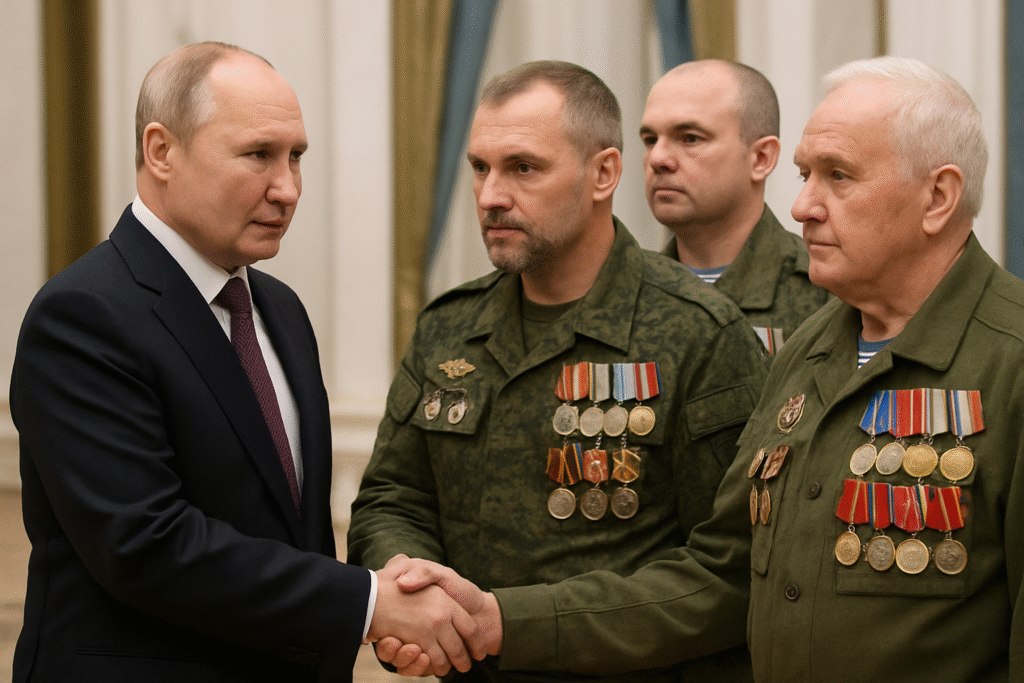
Speaking over tea and cakes with veterans of the Ukraine war, Putin revealed that Russia had recently tested its Poseidon underwater drone, a nuclear-powered, nuclear-capable torpedo-like weapon capable of traveling at 200 km/h (120 mph) through unpredictable routes.
“There is nothing like this,” Putin said. A senior Russian lawmaker went further, saying the Poseidon could “put entire states out of operation.” Russian media first reported on the Poseidon in 2018, boasting that its range and mobility would make it nearly impossible to intercept.
Putin’s announcement follows Moscow’s recent test of the Burevestnik, a nuclear-powered cruise missile with an “unlimited range.” “It’s a unique product, unmatched in the world,” Putin claimed, adding that the missile was so new “we are yet to identify what class of weapons [it] belongs to.”
Experts Question Military Viability
Despite Putin’s bold claims, defense analysts have cast doubt on the weapons’ effectiveness and practicality.
“These are basically Armageddon weapons — too powerful to be used unless you’re happy to destroy the world,” said Mark Galeotti, a Russia scholar and long-time observer of Russian politics.
Both the Poseidon and the Burevestnik are considered second-strike, retaliatory weapons, meaning they would only be used in response to an enemy nuclear attack. “Not even the most rabid Kremlin propagandists are suggesting anyone is preparing to strike Russia,” Galeotti added.
The reliability of the technology also remains uncertain. In 2019, five Russian engineers died in a rocket explosion believed to be linked to the Burevestnik program. The International Institute for Strategic Studies (IISS) later concluded that Russia faced “considerable technical challenges” in ensuring the nuclear propulsion systems’ reliability.
The Timing: Political Significance Over Military Reality
Both the Poseidon and Burevestnik were first introduced in 2018 as part of a suite of so-called “invincible” weapons. What stands out now, analysts say, is the timing of their reappearance.
Putin’s announcement came just days after the White House canceled a planned Trump-Putin summit, reportedly after Secretary of State Marco Rubio concluded that U.S. and Russian positions on the Ukraine war were too far apart.
Since then, Trump has imposed sanctions on two major Russian oil companies over Moscow’s refusal to agree to a peace framework for Ukraine. Putin’s renewed weapons rhetoric may be aimed at regaining leverage.
“In the face of Trump blowing hot and cold with his support for Ukraine or sympathy toward Russia, this is Moscow reminding him it still holds powerful cards,” Galeotti told the BBC.
A Stalled War and Strategic Posturing
Nearly four years after launching its full-scale invasion, Russia’s forces remain mired in a grinding, costly war in Ukraine with little to show in territorial gains.
“The announcements about the Burevestnik and Poseidon reflect the weakness of Russia’s conventional forces,” said David Heathcote, head of intelligence at McKenzie Intelligence Services. “When their army is bogged down, they resort to exaggerated nuclear posturing.”
Russia, isolated and without formal military alliances, continues to rely heavily on nuclear deterrence as a symbol of power projection.
Trump Responds by Restarting U.S. Nuclear Tests
Following Putin’s statements, President Trump announced plans to restart U.S. nuclear weapons testing after a 33-year pause. “With others doing testing, I think it’s appropriate that we do also,” Trump said, framing the move as a necessity to keep pace with Russia and China.
Although the timeline remains unclear, defense experts believe Washington could soon conduct flight tests of intercontinental ballistic missiles (ICBMs) or other nuclear-capable systems.
Kremlin spokesperson Dmitry Peskov swiftly pushed back, suggesting Trump had been misinformed. “The Russian tests cannot in any way be interpreted as a nuclear test,” he said.
Still, the exchange underscores a resurgent nuclear rivalry reminiscent of the Cold War — one that experts warn could destabilize global arms control efforts just as tensions in Ukraine, the Middle East, and the Pacific continue to rise.