
By Harshit, 30 October 2025, 5 AM EDT
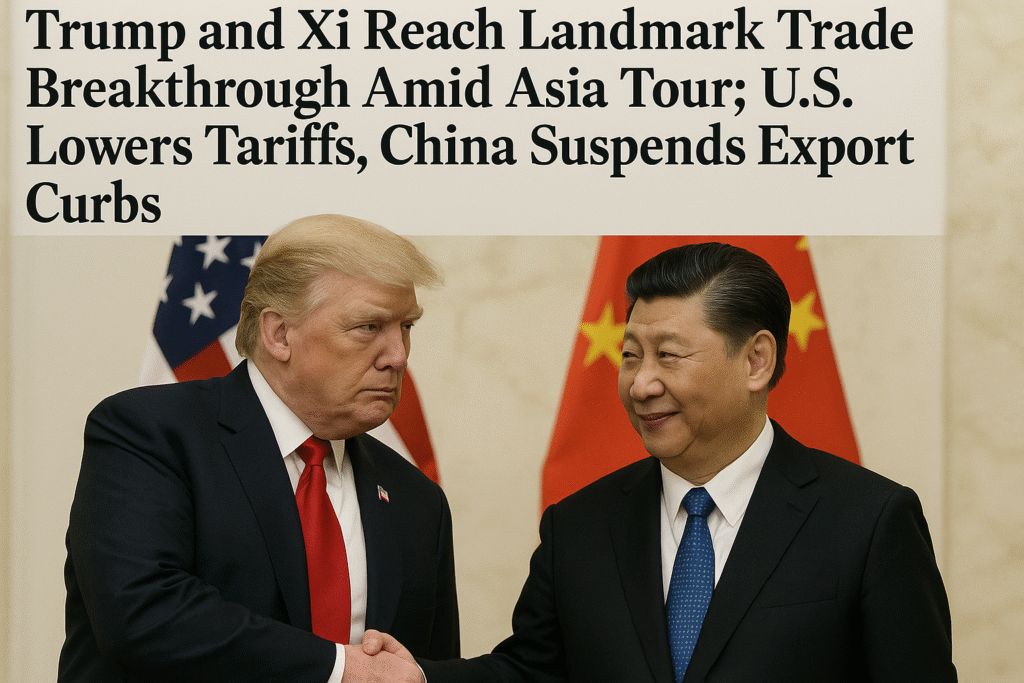
In a significant turn for global trade and diplomacy, U.S. President Donald Trump announced on Friday that the United States and China have reached a broad consensus on key economic and security issues following his meeting with Chinese President Xi Jinping in Busan, South Korea. The talks mark the most substantial thaw in U.S.–China relations since the start of Trump’s second term and signal a potential easing of years-long tensions that have rattled global markets and geopolitical alliances.
A Meeting with Global Stakes
The highly anticipated summit between Trump and Xi took place on the sidelines of Trump’s three-nation Asian tour, which included stops in Malaysia, Japan, and South Korea. The meeting was described by both sides as “constructive” and “forward-looking,” focusing on trade, technology, narcotics control, and military stability.
President Trump said the two sides had come to an agreement on “almost everything,” adding that overall tariffs on Chinese goods would drop from 57% to 47% following breakthroughs in several contentious areas — particularly soybean imports, rare earth mineral exports, and fentanyl control.
“We’ve made tremendous progress — really historic progress,” Trump told reporters aboard Air Force One before departing Busan. “President Xi and I agreed on steps that are fair to both sides. This is a win for American workers, and it’s a win for global stability.”
Xi Jinping, in remarks released by China’s Foreign Ministry, emphasized “mutual respect and reciprocity,” calling the agreement “a reflection of maturity in the world’s two largest economies.” He added that both sides must now ensure “follow-up actions deliver tangible results.”
China’s Concessions: A Pause in the Trade War
Beijing confirmed through its Commerce Ministry that it would suspend its latest rare earth export restrictions and special port fees targeting U.S. ships — measures that had threatened to further escalate the trade war. The suspension will last for one year, corresponding to Washington’s decision to pause its new export control rules on Chinese subsidiaries.
“The Chinese side will make corresponding adjustments to its countermeasures,” said a ministry spokesperson. “This includes pausing curbs on critical minerals and ensuring smooth port access for U.S. vessels.”
Rare earth minerals are vital for manufacturing semiconductors, electric vehicles, and defense systems. Analysts say this temporary reprieve could stabilize global supply chains and ease pressure on manufacturers who had faced soaring costs.
The move also reflects China’s strategic calculation to balance confrontation with cooperation, especially as its economy navigates a delicate post-pandemic recovery.
U.S. Eases Tariffs, Links Fentanyl Action to Trade
The United States, in turn, announced it will lower tariffs by 10 percentage points, citing “strong action” by China to stem the flow of fentanyl — a powerful synthetic opioid — into the American market. The issue has been a key sticking point in bilateral talks, with Washington demanding verifiable enforcement to curb illegal shipments.
Trump said the deal would “save American lives while keeping American industries competitive.”
“The Chinese government has taken significant steps on fentanyl production oversight, and we recognize that,” Trump said. “This cooperation is critical to our national security and public health.”
Both sides also agreed to extend existing tariff exclusion measures, effectively ending months of tit-for-tat escalations that had strained business sentiment worldwide.
A Reprieve in a Costly Trade War
The breakthrough represents a much-needed respite in the ongoing U.S.–China tariff war, which has dragged on for years. Under Trump’s administration, tariffs on Chinese goods had surged to unprecedented levels, disrupting industries and prompting retaliatory measures from Beijing.
Economists say the reduction in tariffs could provide a modest boost to global trade and investor confidence, particularly across Asia. “This agreement temporarily halts an economic slide that was beginning to impact both sides,” said Dr. Jayant Menon, a senior fellow at Singapore’s ISEAS–Yusof Ishak Institute. “But the long-term sustainability will depend on how faithfully these commitments are implemented.”
Menon noted that China’s measured reaction — agreeing to limited concessions while maintaining a strong diplomatic tone — showed Beijing was “not going to be bullied.”
Diplomacy Through Gold and Gifts
Throughout his whirlwind Asian tour, President Trump was met with lavish receptions and elaborate gestures of goodwill. In Malaysia, he danced impromptu on the red carpet before signing the Thailand–Cambodia peace accord. In Japan, Prime Minister Sanae Takaichi presented Trump with a golf putter once owned by the late Shinzo Abe, along with a gold-leaf golf ball and a bag signed by Hideki Matsuyama.
In South Korea, President Lee Jae Myung awarded Trump the Grand Order of Mugunghwa — the nation’s highest civilian honor — and presented him with a replica of an ancient Silla golden crown at the Gyeongju National Museum.
Observers noted the symbolic use of gold — a color long associated with Trump’s personal brand — and interpreted it as a calculated diplomatic strategy to appeal to the president’s sensibilities.
“Flattery was used as a political tool,” said Professor Han Soo-yeon of Seoul National University. “But it also reflects a pragmatic approach — Asian leaders needed results, and Trump responded positively to personal gestures.”
Defense and Security: Nuclear Testing Announcement
While trade dominated the headlines, Trump’s visit also took a dramatic turn on the security front. Before his meeting with Xi, Trump directed the Department of Defense to “immediately begin testing nuclear weapons on an equal basis,” citing concerns over “advanced weapons testing by rival nations, including China and Russia.”
The move effectively ends a 30-year moratorium on U.S. nuclear testing that began in 1992.
China’s Ministry of Foreign Affairs expressed concern, urging Washington to “earnestly uphold its obligations under the Comprehensive Nuclear-Test-Ban Treaty” and safeguard international stability.
“We hope the U.S. will take concrete actions to maintain global strategic balance,” said Senior Colonel Zhang Xiaogang, a spokesperson for China’s Defense Ministry.
Experts warn that renewed testing could destabilize decades of non-proliferation efforts. “If the U.S. resumes nuclear tests, it opens the door for others to do the same,” said Dr. Mei Ling, an arms control expert at Beijing University. “It would mark the beginning of a dangerous new phase in the arms race.”
TikTok and Tech Tensions Eased
The TikTok dispute, another flashpoint in U.S.–China relations, was also addressed during side meetings in Kuala Lumpur earlier in the week. China’s Commerce Ministry said it would “properly address” concerns surrounding TikTok’s U.S. operations.
U.S. Treasury Secretary Scott Bessent later confirmed that both sides had reached a “final deal on TikTok,” paving the way for continued U.S. operations under restructured ownership terms.
“As of today, all the details are ironed out,” Bessent told CBS Sunday. “That will be for the two leaders to consummate that transaction.”
Under U.S. law passed last year, TikTok’s parent company ByteDance was required to divest its American assets due to national security concerns. The apparent agreement could mark a major step toward resolving one of the thorniest issues in U.S.–China tech relations.
Economic Cooperation and Future Visits
China’s Foreign Ministry released a statement confirming that the two nations had “reached a consensus on important economic and trade issues” and agreed to refine follow-up work quickly.
Xi emphasized that both nations should focus on “the long-term benefits of cooperation rather than falling into a vicious cycle of retaliation.”
Trump, for his part, announced plans to visit Beijing in April 2026, extending an invitation for Xi to visit Washington later next year. “We’re entering a new chapter,” Trump said. “The United States and China can compete — but we can also cooperate.”
Global Reaction and Market Response
Global markets responded positively to news of the trade breakthrough. The Dow Jones Industrial Average rose 2.3% in early trading, while Asian indices rallied across Tokyo, Shanghai, and Seoul. Commodity prices, particularly soybeans and rare earth minerals, stabilized after months of volatility.
European leaders cautiously welcomed the development. “De-escalation between Washington and Beijing benefits the global economy,” said European Commission President Ursula von der Leyen. “But we urge both sides to prioritize multilateral engagement.”
In contrast, human rights advocates criticized the agreement for omitting references to technology censorship and surveillance exports. “Economic cooperation should not come at the cost of accountability,” said Amnesty International in a statement.
Analysis: A Pragmatic Pause, Not a Permanent Peace
Analysts caution that despite the optimistic tone, the agreement represents a pause rather than a resolution. Deep structural tensions — from intellectual property to military posturing in the South China Sea — remain unresolved.
“Trump has achieved a tactical victory,” said Dr. David Shambaugh, a China scholar at George Washington University. “But without a long-term framework, these truces tend to be short-lived.”
Still, the symbolism of Trump and Xi standing side-by-side in Busan — after years of tariff escalation and mutual distrust — marks a significant step toward stability in an increasingly fragmented world order.