
By HarshitKingston, Jamaica | Tuesday, October 28, 2025 12:30 PM EDT
A Catastrophe Looming Over Jamaica
Driven by devastating sustained winds of 185 mph, Hurricane Melissa — now confirmed as one of the most powerful Atlantic hurricanes in recorded history — is on the verge of making landfall in Jamaica, threatening to unleash a humanitarian catastrophe across the island. The UN Weather Agency has described it as the “storm of the century,” warning that Jamaica will likely face a disaster with long-lasting consequences.
Melissa has already claimed seven lives — three in Jamaica during last-minute preparations, three in Haiti, and one in the Dominican Republic. The National Hurricane Center (NHC) issued a final urgent warning early Tuesday: “This is your last chance to protect your life. Take cover now.”
As of noon Eastern Time, Melissa’s eye — the calm center of the storm — was beginning to touch Jamaica’s southern coast, with its full landfall expected within the hour. The storm’s central pressure measured 892 millibars, placing it in extremely rare company: only two hurricanes in Atlantic history — Wilma (2005) and Gilbert (1988) — have registered lower pressure readings.
A Nation Under Siege
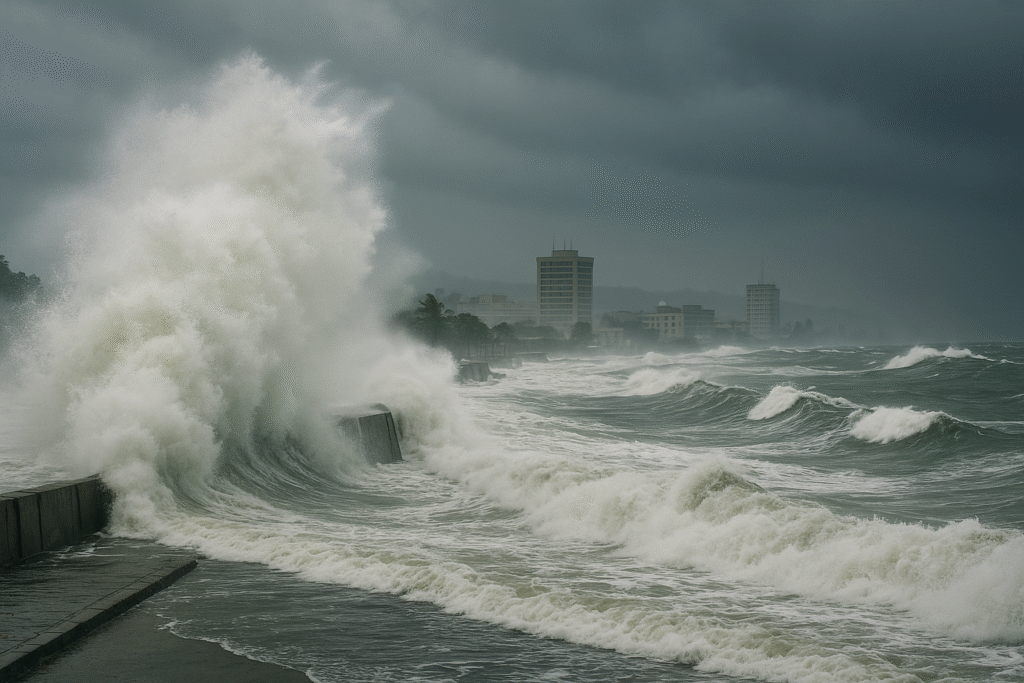
On the ground, Jamaica is already feeling the hurricane’s wrath. In Montego Bay, torrential rain and violent winds have begun tearing through neighborhoods, toppling trees and ripping apart rooftops. Daryl Vaz, Jamaica’s Minister for Science, Energy, Telecommunications and Transport, said during a live press briefing that 35% of the island’s population — nearly 240,000 residents — were already without power before landfall.
“Several generation units and high-voltage substations have been forced offline due to hurricane-force winds,” Vaz confirmed, emphasizing that critical infrastructure such as hospitals remain operational on generator power. “There is no plan at this point to shut down the grid entirely,” he added, as crews worked to restore electricity where possible.
In Kingston, the nation’s capital, Mayor Andrew Swaby warned residents to brace for “catastrophic impacts” but assured them that emergency teams were positioned to respond immediately once conditions allow. “We have pre-positioned heavy-duty equipment around Kingston,” Swaby told CNN. “Our goal is to recover as quickly as possible, because Kingston is the center of government and the heart of Jamaica’s economy.”
“The Whole Coastline Is Gone” — Voices from the Storm
From the southwestern coastal village of Alligator Pond, Evrol Christian, a local restaurant owner, described the terrifying conditions as the hurricane’s outer eyewall lashed his community.
“The sea level is coming over the wall and we’re in serious trouble,” Christian said via a phone interview with CNN’s Zain Asher, as howling winds roared in the background. “Everybody in Alligator Pond is crying out now. The waves are 15 feet high, and the wind speed — it’s like I can see the wind.”
Christian, who had decided against evacuating earlier, expressed deep regret: “I’m sorry I didn’t take the bus yesterday to higher ground. The whole coastline is gone.”
Further north, Kristin Morgan, an American mother stranded in Lucea, near Montego Bay, said she was hunkering down in a hotel room, unable to leave as flights were grounded and airports closed. “I just want to get home to my children,” she said. “The wind is out of control — it’s a gray blast outside. There is no sign of life whatsoever.”
Melissa’s Unprecedented Power
Meteorologists say Melissa’s sustained winds of 185 mph make it the second-strongest Atlantic storm ever recorded by wind speed, tied with several historic hurricanes and trailing only Hurricane Allen (190 mph, 1980).
The storm’s rapid intensification stunned experts. Just two days ago, Melissa was a Category 3 storm. Within 36 hours, it exploded into a Category 5 — the highest level on the Saffir-Simpson scale — fueled by unusually warm ocean temperatures exceeding 31°C (88°F).
“The pressure drop to 892 millibars is nearly unprecedented,” said Mary Gilbert, a meteorologist with CNN. “Only two Atlantic storms have ever recorded lower pressures, and both caused catastrophic damage.”
As Melissa’s eyewall — the band of strongest winds surrounding the calm center — moves inland, Jamaica’s central and western parishes are expected to bear the brunt of the storm. Evan Thompson, Jamaica’s Meteorological Service director, warned that up to 75 centimeters (30 inches) of rain could fall over two days. “Flooding, landslides, and storm surges are inevitable,” he said.
Stripping Jamaica Bare
Meteorologists also warned of massive defoliation — the stripping of leaves and trees — similar to what occurred in Puerto Rico after Hurricane Maria (2017).
“Hurricanes with winds like Melissa’s can strip tropical forests bare, leaving brown, leafless landscapes visible even from space,” said Chris Dolce, a CNN meteorologist. NASA satellite data after Maria showed 87% of tree trunks in Puerto Rico survived, allowing recovery. Experts hope Jamaica’s dense mountain forests might show similar resilience, but the destruction is expected to be severe.
Communities Braced and Resilient
Despite the looming disaster, many Jamaicans say they feel as ready as possible. Mateo Avalle Piber, a Kingston resident living in the hills about 10 km from the coast, told CNN he and his family were staying put.
“Our house was built with this kind of storm in mind,” he said. “We’re nervous — even the cat is panicking — but we’ve prepared food, water, and batteries for at least a week.”
He added that government communication had been clear and timely: “There’s a good sense of community here. People are talking, sharing information, and making sure everyone is ready.”
Regional and Global Implications
Meteorologists warn that after tearing through Jamaica, Melissa will likely weaken slightly but remain powerful as it tracks north toward Cuba and possibly southern Florida by late week. The U.S. National Hurricane Center said it is monitoring the storm closely for potential impacts on the Bahamas and Florida Keys.
International aid agencies have already begun coordinating potential relief missions. The United Nations Office for Disaster Risk Reduction said teams were on standby to provide emergency shelter, food, and medical assistance once the storm passes.
“Hurricane Melissa will reshape Jamaica for years to come,” the agency warned. “It’s not just the wind or the rain — it’s the total collapse of infrastructure and the human toll that will follow.”