
By Harshit, October 27, 2025 | South China Sea | 10:00 AM CST
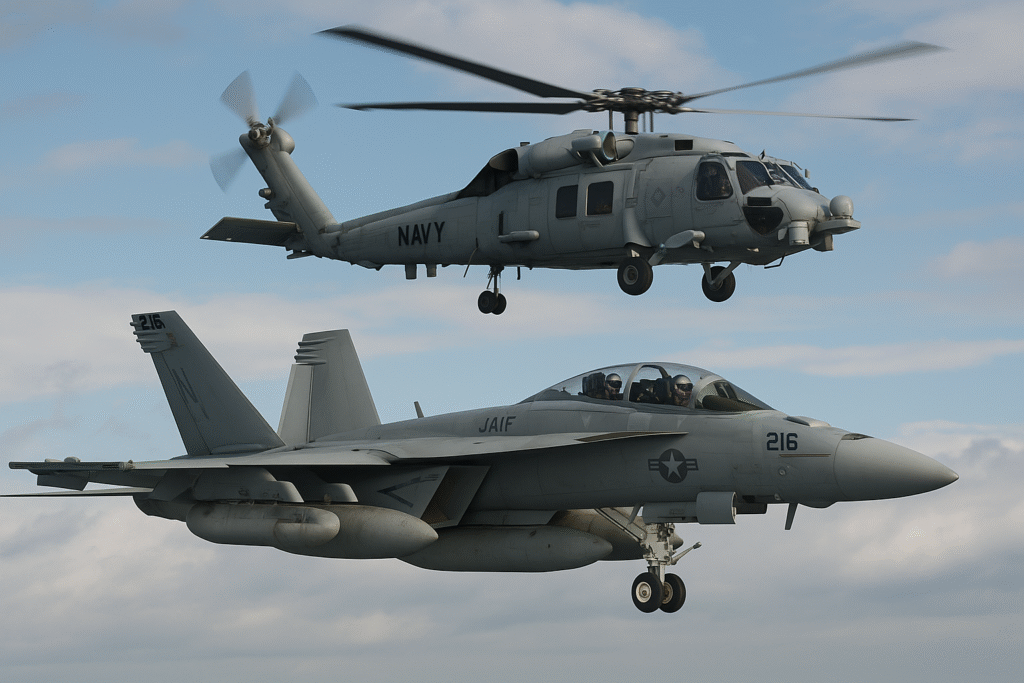
Two U.S. Navy aircraft — a MH-60R Seahawk helicopter and an F/A-18F Super Hornet fighter jet — crashed during separate routine operations over the South China Sea on Sunday, the Navy’s Pacific Fleet confirmed. All crew members were rescued safely, but the incidents have raised serious questions about possible systemic issues or equipment malfunctions.
Back-to-Back Crashes Shock U.S. Pacific Fleet
According to official statements, the first crash occurred around 2:45 p.m. local time when a Seahawk helicopter went down while conducting standard flight operations from the aircraft carrier USS Nimitz, one of the U.S. Navy’s most powerful and oldest active warships.
The helicopter’s three crew members were rescued within minutes by nearby recovery teams. Roughly 30 minutes later, a $60 million F/A-18F Super Hornet also crashed while performing operations from the same carrier. Both pilots ejected safely and were recovered by search-and-rescue crews.
The Navy said an investigation is underway to determine the cause of both crashes, which occurred in the same operational zone — a rare and concerning coincidence for U.S. naval aviation.
Trump Suggests Fuel Contamination
Speaking aboard Air Force One en route from Malaysia to Japan on Monday, U.S. President Donald Trump called the twin crashes “very unusual” and floated the possibility of fuel contamination as a cause.
“They think it might be bad fuel. We’re gonna find out. Nothing to hide,” Trump told reporters, emphasizing transparency as the investigation continues.
The White House confirmed that the President has been briefed on the incidents and has asked the Department of Defense for a preliminary report by the end of the week.
Strategic Waters and Rising Tensions
The crashes took place over the South China Sea, a region already brimming with geopolitical tension. The area is claimed by multiple countries, including the Philippines, Vietnam, Malaysia, Brunei, and Taiwan, but China insists on ownership of nearly the entire waterway — in defiance of international rulings.
Over the past two decades, Beijing has built military outposts and airstrips on several disputed islands and reefs, sparking global concern. The United States routinely conducts “freedom of navigation” operations to challenge China’s expansive claims and reassure allies in Southeast Asia.
The loss of two high-value aircraft in such a contested zone — even if accidental — has strategic implications. Analysts warn that China may use the event to question U.S. operational safety or portray American presence as destabilizing.
Diplomatic Undertones
The crashes coincided with Trump’s multi-nation Asia tour, where he is set to meet Chinese leader Xi Jinping later this week for critical trade discussions. Relations between Washington and Beijing had recently soured after both nations imposed new trade measures following months of relative calm.
However, U.S. Treasury Secretary Scott Bessent said on Sunday that both sides had reached a preliminary framework for a trade agreement, potentially easing tensions ahead of the high-stakes Trump–Xi meeting.
Observers note that while the accidents may not have direct political links, the timing could complicate U.S. messaging in the region — especially as the Navy continues to assert its presence amid growing Chinese military assertiveness.
Recurring Technical Issues
The Navy has suffered a string of aviation mishaps in 2025 alone. Prior to Sunday’s incidents, two F/A-18 fighters were lost in the Red Sea earlier this year — one sliding off a carrier deck and another crashing during a landing attempt.
In August, another Super Hornet crashed off the coast of Virginia during a training exercise. While all crew members survived, investigators have since been probing whether aging hardware, pilot fatigue, or maintenance gaps contributed to the growing list of accidents.
The USS Nimitz, commissioned in 1975, remains the oldest active U.S. aircraft carrier and is slated for retirement next year. Naval experts have long cautioned that maintaining older platforms like the Nimitz places additional strain on both aircraft and flight crews.
Next Steps
The U.S. Navy has not released the exact coordinates of the crash sites, citing operational security, but confirmed that recovery operations are ongoing. The Navy will work closely with defense engineers to analyze mechanical components, fuel samples, and flight data from both aircraft.
Pentagon officials have also briefed allies in the Indo-Pacific region, including Japan and the Philippines, to assure them that no hostile activity was involved.
While all crew members survived, the twin crashes mark another challenging moment for U.S. naval aviation — and come at a politically sensitive time for Washington’s presence in Asia