
By Harshit | 26 October 2025 | Bishkek | 11:30 AM
Kyrgyzstan Enters the Digital Currency Age
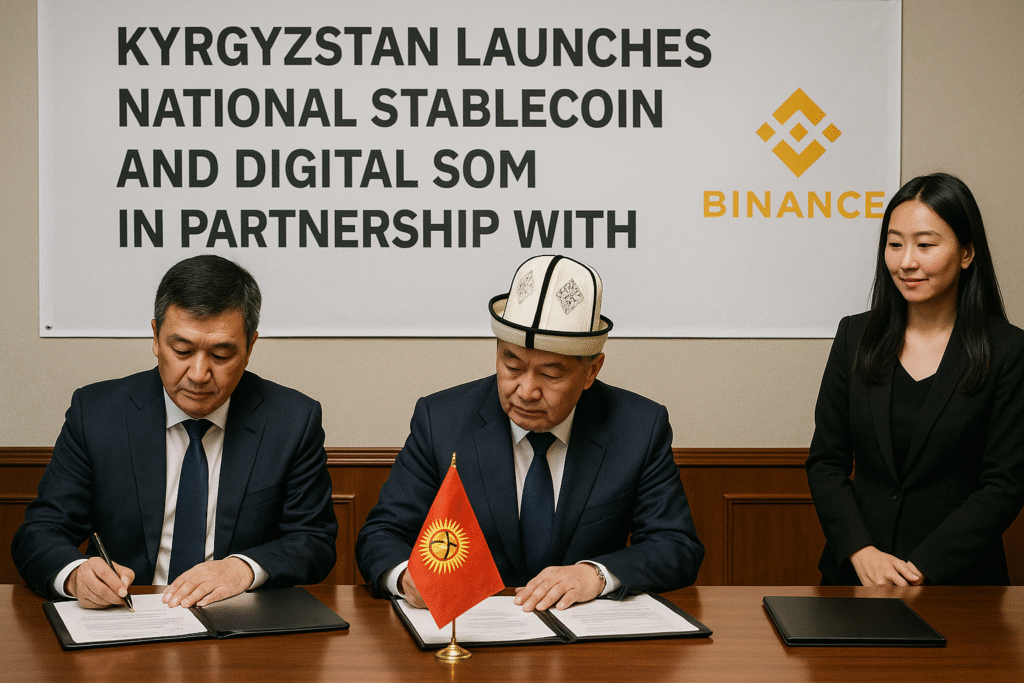
Kyrgyzstan has taken a significant step into the world of digital finance with the launch of a national stablecoin and a central bank digital currency (CBDC), President Sadyr Japarov announced on Saturday. The project is being executed in collaboration with cryptocurrency exchange Binance, reflecting the country’s growing ambition to become a leader in cryptocurrency adoption in Central Asia.
The newly launched stablecoin, A5A7, is pegged to the Russian rouble and is officially based in Kyrgyzstan. Simultaneously, a digital version of Kyrgyzstan’s national currency, the som, has been made available for government payments, representing a significant milestone in the country’s efforts to modernize its financial infrastructure.
Changpeng Zhao, founder of Binance and appointed in May as an adviser on digital assets to the Kyrgyz president, confirmed that the stablecoin is launched on Binance’s BNB Chain, while a national cryptocurrency reserve has been established, which includes Binance’s BNB token. This reserve is expected to help stabilize the newly launched digital currencies and support broader adoption across the country.
Strategic Cryptocurrency Adoption
Kyrgyzstan has historically relied heavily on remittances from labor migrants in Russia, which account for a substantial part of its economy. In recent years, the country has sought to position itself as a cryptocurrency-friendly nation, attracting fintech innovation and experimenting with blockchain-backed financial systems. By creating a stablecoin and a digital som, Kyrgyzstan aims to reduce dependence on traditional banking infrastructure, streamline government payments, and strengthen its position in regional digital finance.
The new system is expected to facilitate faster, more secure transactions, especially for government services, while giving Kyrgyzstan an early lead among Central Asian countries in digital currency adoption. Zhao highlighted that the digital som is ready for government use, signaling that Kyrgyzstan is aiming not just for speculative cryptocurrency use but for practical financial applications.
Controversy and Sanctions
While the launch marks a technological achievement, it is not without controversy. The stablecoin A5A7 is backed by the Russian rouble and has previously been targeted by Western sanctions, which claim it may be used to bypass international restrictions imposed on Russia over the Ukraine conflict. Despite these challenges, Kyrgyzstan has pushed ahead, emphasizing that the project is designed for domestic financial modernization rather than geopolitical maneuvering.
Experts note that the sanctions underscore the geopolitical sensitivity of digital currencies when used by countries closely linked to sanctioned economies. At the same time, the launch demonstrates Kyrgyzstan’s determination to leverage blockchain technology for economic and governmental purposes, while working closely with international cryptocurrency actors like Binance.
Political and Regional Context
Kyrgyzstan was traditionally considered the most democratic of the five former Soviet republics in Central Asia. However, since coming to power after mass protests in 2020, President Japarov has consolidated political power and curtailed dissent. The country is scheduled to hold snap parliamentary elections on 30 November, with Japarov’s allies seeking to further expand their dominance in the legislature.
The launch of a national stablecoin and digital som also comes as a strategic economic move that may appeal to younger, tech-savvy voters and investors interested in cryptocurrency, while signaling Kyrgyzstan’s ability to compete in the region’s emerging digital economy.
Implications for Central Asia and Beyond
The introduction of Kyrgyzstan’s digital currencies could have far-reaching effects for Central Asia. It positions Kyrgyzstan as a trailblazer in blockchain adoption, potentially serving as a model for other nations exploring CBDCs or national stablecoins. The government’s integration of a digital som for official payments may help streamline public sector operations, reduce costs, and increase transparency in financial transactions.
However, the launch also raises questions about financial stability and regulatory oversight, particularly given the involvement of a private cryptocurrency firm like Binance and the stablecoin’s connection to the Russian rouble. Analysts warn that while the project could modernize Kyrgyzstan’s financial system, external sanctions and political pressures could complicate its international acceptance and usage.
Despite these challenges, the partnership with Binance and the creation of a national cryptocurrency reserve underscore Kyrgyzstan’s ambition to combine traditional currency stability with blockchain innovation, reflecting a growing trend among smaller nations to embrace digital financial solutions.