
By Harshit, Caracas/Washington — October 25, 2025 6 AM EDT
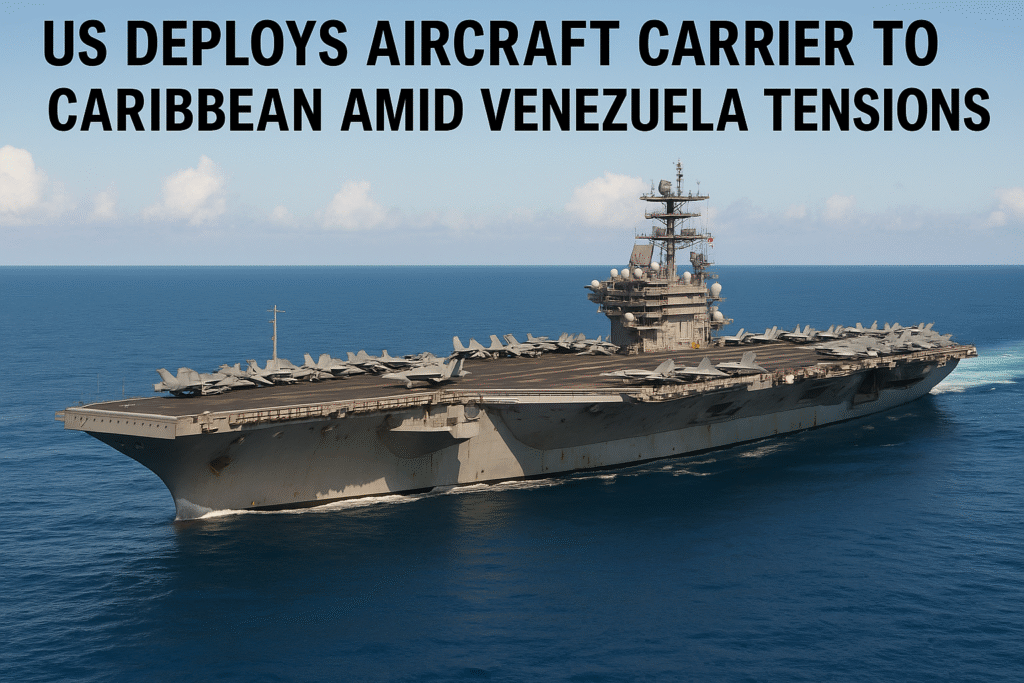
Venezuela’s President Nicolás Maduro has accused the United States of “fabricating a new war” after Washington sent the USS Gerald R. Ford, the world’s largest aircraft carrier, to the Caribbean. The deployment comes amid an intensifying US campaign against alleged drug trafficking networks linked to Venezuela, with airstrikes killing at least 43 people since September.
US Military Build-Up in the Caribbean
The USS Gerald R. Ford can carry up to 90 aircraft and represents a major escalation of US military firepower in the region. According to the Pentagon, the carrier and accompanying forces are tasked with enhancing operations to disrupt narcotics trafficking and dismantle transnational criminal organisations.
US President Donald Trump has repeatedly accused Maduro of leading a drug trafficking organisation, an allegation the Venezuelan leader denies. Trump has also raised the possibility of land operations in Venezuela, claiming the US “has the sea very well under control.”
Additional US military aircraft have been identified across Puerto Rico, reinforcing Washington’s strategic presence in the Caribbean and northern South America.
Maduro Denounces US Actions
In a televised statement, Maduro accused the United States of fabricating a “new eternal war,” arguing that Washington is seeking regime change rather than solely targeting drug traffickers.
“They promised they would never again get involved in a war, and they are fabricating a war,” Maduro told state media.
Experts suggest the military build-up is intended as a form of psychological pressure on Maduro’s inner circle and Venezuelan military, encouraging defections or political moves against the president.
“This is about regime change. They’re probably not going to invade, the hope is this is about signalling,” said Dr. Christopher Sabatini, a senior fellow for Latin America at Chatham House.
US Air Strikes and Drug Enforcement Operations
Since early September, the Trump administration has conducted ten air strikes against vessels alleged to be transporting narcotics. Most have occurred in the Caribbean and off South America’s coast, with some strikes in the Pacific Ocean on October 21–22.
On Friday, US Defence Secretary Pete Hegseth reported the killing of “six male narco-terrorists” linked to the Tren de Aragua, a Venezuela-based transnational criminal organisation designated a terrorist group by the US State Department.
While the Pentagon frames these operations as part of a drug interdiction mission, critics argue that the scale of the deployment exceeds what is necessary for maritime drug enforcement.
Legal and Congressional Concerns
The legality of the US strikes has drawn scrutiny. At least 43 people have died since the operations began, prompting questions from both Democrats and Republicans in Congress.
On September 10, 25 Democratic senators wrote to the White House expressing concern that previous strikes “lacked evidence” that the vessels or individuals posed a direct threat to the United States. Republican Senator Rand Paul argued that such actions require congressional approval.
Trump maintains that he has legal authority to order the strikes but stated that any land operations “may go back to Congress.”
Brian Finucane, a former US State Department lawyer, described the situation as a potential constitutional crisis, noting that “Congress has principal control over the use of military force. That control has been usurped in this instance by the White House.”
Regional Reactions and Implications
The US military escalation has drawn concern throughout Latin America, with analysts warning that the operation could destabilize the region. Maduro’s government has called for international scrutiny, accusing the US of interference in Venezuela’s sovereignty.
The deployment of the USS Gerald R. Ford marks the most significant US military presence near Venezuela in years and signals Washington’s willingness to intensify pressure on Maduro, either through military, political, or economic means.