
By Harshit, Washington, D.C. — October 24, 2025 5 AM EDT
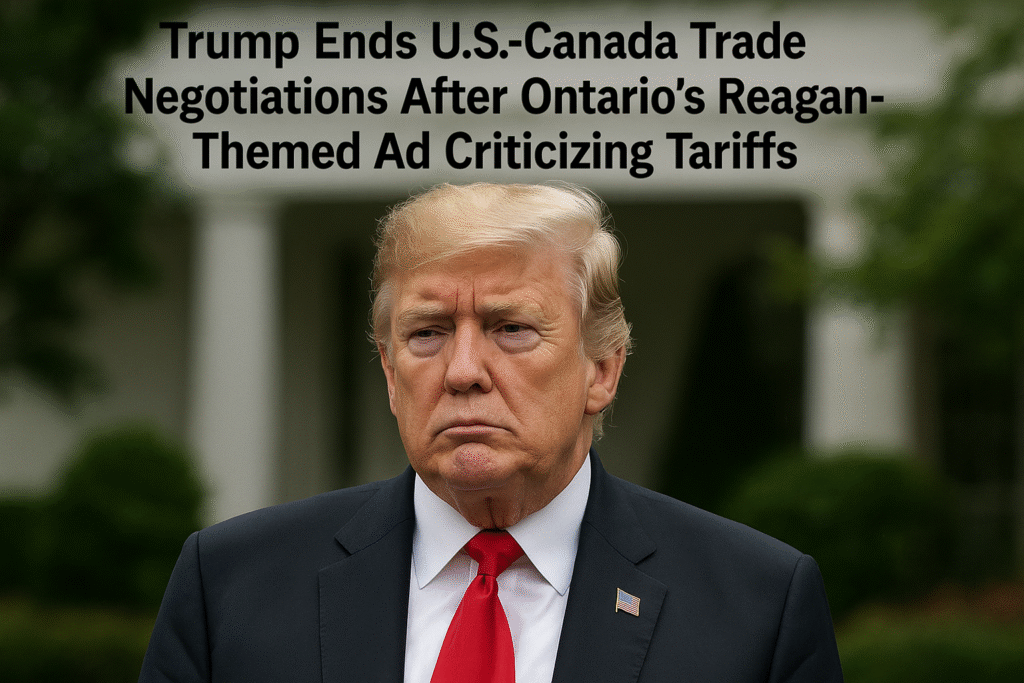
U.S. President Donald Trump abruptly announced an end to all trade negotiations with Canada on Thursday following the release of an advertisement by Ontario’s provincial government that used audio from former President Ronald Reagan to criticize Trump’s sweeping tariffs. The ad, which aired on American television networks, quoted Reagan warning that tariffs “hurt every American,” igniting a fierce backlash from the White House.
Trump’s Reaction: “Talks Are Hereby Terminated”
Trump took to social media to condemn the ad as “FAKE” and “egregious,” accusing the Ontario government of interference in U.S. domestic affairs. “Trade talks with Canada are HEREBY TERMINATED,” Trump wrote, asserting that the video sought to influence the upcoming U.S. Supreme Court ruling on the legality of his tariff policy.
The advertisement, funded by Ontario’s Ministry of Economic Development, featured Reagan’s 1987 remarks on free trade — remarks originally aimed at justifying temporary tariffs on Japanese imports. The ad recontextualized the speech to highlight the long-term damage of protectionist trade measures.
Economic Fallout and Ongoing Tariff Dispute
Trump’s administration has imposed a 35% blanket levy on many Canadian imports, alongside additional tariffs specifically targeting sectors like automobile manufacturing and steel production — key pillars of Ontario’s economy.
While Canada’s federal government, led by Prime Minister Mark Carney, has been attempting to negotiate relief from these tariffs, Ontario Premier Doug Ford has emerged as one of Trump’s most outspoken critics. Ford has accused the U.S. of “pulling a knife and yanking it into us,” referring to the economic impact of the tariffs on cross-border businesses and Canadian workers.
Ontario’s $75 million (CAD) campaign, of which the Reagan ad was a centerpiece, sought to appeal directly to American consumers and lawmakers by emphasizing the shared benefits of open trade. The campaign aired on major U.S. networks and online platforms, featuring scenes of factories, stock exchanges, and symbols of U.S.-Canada cooperation — juxtaposed with Reagan’s words on the dangers of protectionism.
Reagan Foundation Condemns “Misrepresentation”
The Ronald Reagan Presidential Foundation and Institute quickly issued a statement rebuking the Ontario government, claiming that the ad used “selective and misleading” excerpts from Reagan’s 1987 address. The foundation noted that Ontario did not seek permission to use or edit the archival footage, and it is now “reviewing legal options” against the provincial government.
The foundation also argued that the ad misrepresented Reagan’s intent — noting that while he had expressed reservations about tariffs, his speech defended their limited use as a strategic necessity in trade negotiations, not a condemnation of all trade restrictions.
Trump cited the Reagan Foundation’s criticism as validation of his decision to terminate trade discussions, saying the ad “distorts history for political propaganda.”
Impact on U.S.-Canada Relations
The rupture marks the second time Trump has halted trade talks with Canada this year. Earlier in 2025, he froze negotiations after Ottawa introduced a digital services tax on American tech giants such as Google, Meta, and Amazon. Talks resumed only after Canada rescinded the measure under mounting U.S. pressure — a move the White House called “a win for American workers.”
However, this latest breakdown could have more lasting consequences. Canada is America’s largest trading partner after Mexico, with cross-border trade exceeding $800 billion annually. Ontario alone accounts for nearly half of all Canadian exports to the U.S.
The tariffs have already led to job losses in Canada’s auto sector and caused supply chain disruptions for U.S. manufacturers dependent on Canadian steel and aluminum.
Political Reactions in Canada
Ontario Premier Doug Ford defended the ad campaign, saying it aimed to highlight the real costs of Trump’s tariffs on both sides of the border. “We’ll never stop making the case against American tariffs on Canada,” Ford wrote in a post accompanying the ad’s release.
Ford’s office declined to comment directly on Trump’s termination announcement but emphasized that Ontario “remains committed to defending Canadian jobs.”
In contrast, Prime Minister Carney’s office adopted a more cautious tone, saying Canada “will continue to pursue diplomacy and dialogue in the best interests of our workers and economy.”
Global Response and Supreme Court Context
Trump’s reference to the Supreme Court underscores the political stakes surrounding the administration’s economic strategy. The Court is scheduled to review whether Trump’s global tariff framework — enacted under emergency national security powers — violates international trade obligations.
China’s embassy in Washington also used similar Reagan clips earlier this year to criticize Trump’s global tariffs, signaling growing international scrutiny of U.S. trade policy.
Analysts warn that the collapse of U.S.-Canada trade talks could further isolate Washington and reignite fears of a broader trade war. “This isn’t just about one ad — it’s about the fragility of North American economic cooperation,” said economist Laura Mendoza of Georgetown University. “When political theater drives trade policy, businesses and workers are the ones who suffer.”
Looking Ahead
While Trump’s decision has drawn strong domestic applause from protectionist supporters, it risks deepening economic uncertainty across North America. For Ontario, whose industries are tightly linked to U.S. markets, the termination of talks may mean prolonged financial pain and escalating political tension.
For now, both sides appear entrenched — Canada signaling restraint, and Trump doubling down on his nationalist trade agenda. Whether this rupture becomes a temporary standoff or the start of a lasting economic divide may depend less on diplomacy and more on the outcome of the Supreme Court’s forthcoming ruling.