
By Harshit | Las Cruces, NM | October 24, 2025 | 1:30 AM EDT
Dinosaurs Were Still Flourishing Just Before the End
A ridge of rocks in New Mexico is offering scientists a rare glimpse into the final days of the dinosaurs. Fossils of crested hadrosaurs, long-necked sauropods, and a variety of plants suggest a thriving ecosystem existed not long before an asteroid struck Earth 66 million years ago, according to a study published October 23 in Science.
“Without this impact, they weren’t on their way out,” says Andrew Flynn, a geologist at New Mexico State University in Las Cruces, highlighting that dinosaurs may have remained plentiful if the asteroid had not intervened.
Dating the Rocks: Pinpointing the Cretaceous-Paleogene Boundary
For decades, scientists debated whether dinosaurs were already in decline before the asteroid impact. Fossil evidence from formations like Hell Creek in the Dakotas, Wyoming, and Montana hinted at a possible reduction in species diversity, but precise dating was challenging.
The Naashoibito Member formation in New Mexico has long been known for its fossil richness. Previous studies dated the rocks anywhere from 70 million to 66 million years old, leaving uncertainty about their proximity to the asteroid event.
Since the site lacks the characteristic clay layer of the Cretaceous-Paleogene boundary, Flynn and his team used a combination of techniques. By examining the magnetic polarity of minerals and the argon isotopes in crystals within the rocks, they determined the youngest layers were 66.38 million years old — placing them in the final hundreds of thousands of years of the Cretaceous.
Comparing Ecosystems Across North America
With the age established, researchers compared the New Mexico fossils to those from Hell Creek. The dominant herbivore in New Mexico was the sauropod Alamosaurus, alongside lambeosaurine hadrosaurs with distinctive crests. Hell Creek, by contrast, lacked Alamosauruses and featured uncrested hadrosaurs.
Flynn explains that these differences likely reflect climate sensitivity, as sauropods may have avoided colder regions. Such variations suggest that ecosystem composition depended on both geography and climate, rather than a uniform decline in species.
Paul Barrett, a paleontologist at the Natural History Museum in London not involved in the study, notes that these findings support the idea that dinosaurs were part of complex, fully functioning ecosystems right up to the asteroid impact. “They could have continued longer if the asteroid hadn’t interrupted them,” he says.
The Broader Debate on Dinosaur Decline
Despite these insights, some researchers caution against overgeneralizing. Manabu Sakamoto of the University of Reading, who has argued in previous studies that dinosaurs entered decline millions of years before the extinction, notes that the new findings don’t fully settle the debate.
Sakamoto explains that while certain species went extinct, they were often replaced by similar dinosaurs, maintaining a consistent ecological role. “It’s not replaced by some new species of another dinosaur that does something totally different,” he says.
Nevertheless, the consensus remains that the asteroid triggered environmental upheaval that non-avian dinosaurs, unlike mammals, could not survive. Barrett emphasizes that studying these ancient responses can provide lessons for understanding how animals and plants react to major environmental changes.
A Snapshot of Life Before the Catastrophe
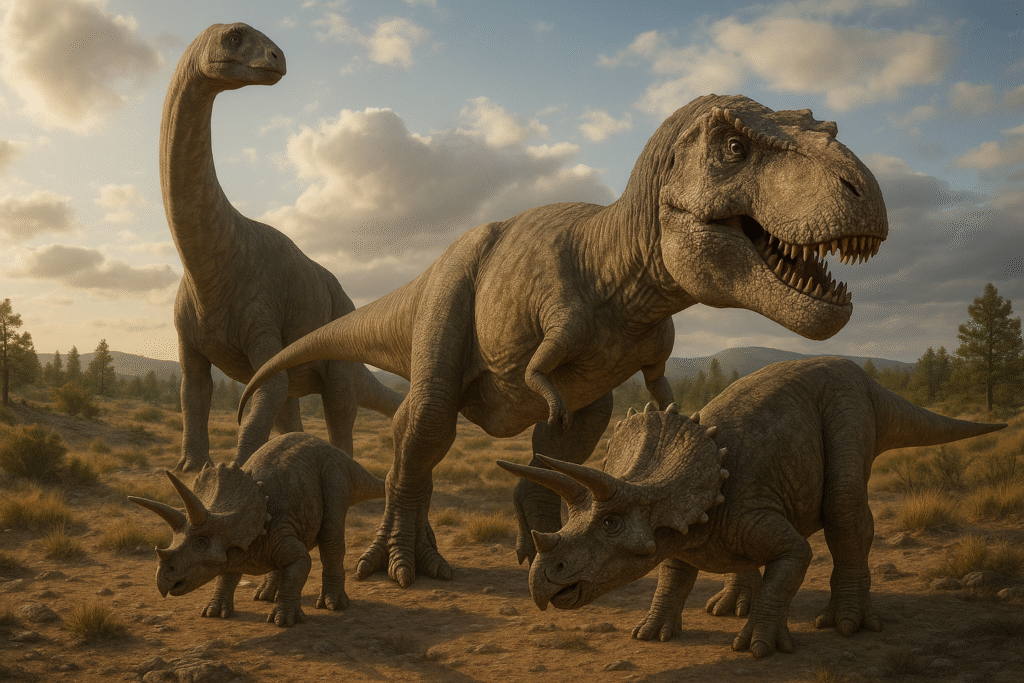
The Naashoibito Member’s fossils preserve a vibrant snapshot of late Cretaceous life. Sauropods and hadrosaurs grazed alongside diverse plant life, illustrating that North America hosted varied and resilient ecosystems right up to the end.
“This study provides one of the clearest pieces of evidence that dinosaurs weren’t gradually dying out before the asteroid struck,” Flynn says. It underscores the suddenness of their extinction and highlights the role of catastrophic events in shaping life on Earth.
While the patchy fossil record still leaves questions, the New Mexico site adds a crucial piece to the puzzle of dinosaur extinction, revealing that life was far from declining when the asteroid changed the course of history.