
By Harshit, New Delhi | October 23, 2025
Tariffs Cast a Shadow Over Diwali Cheer
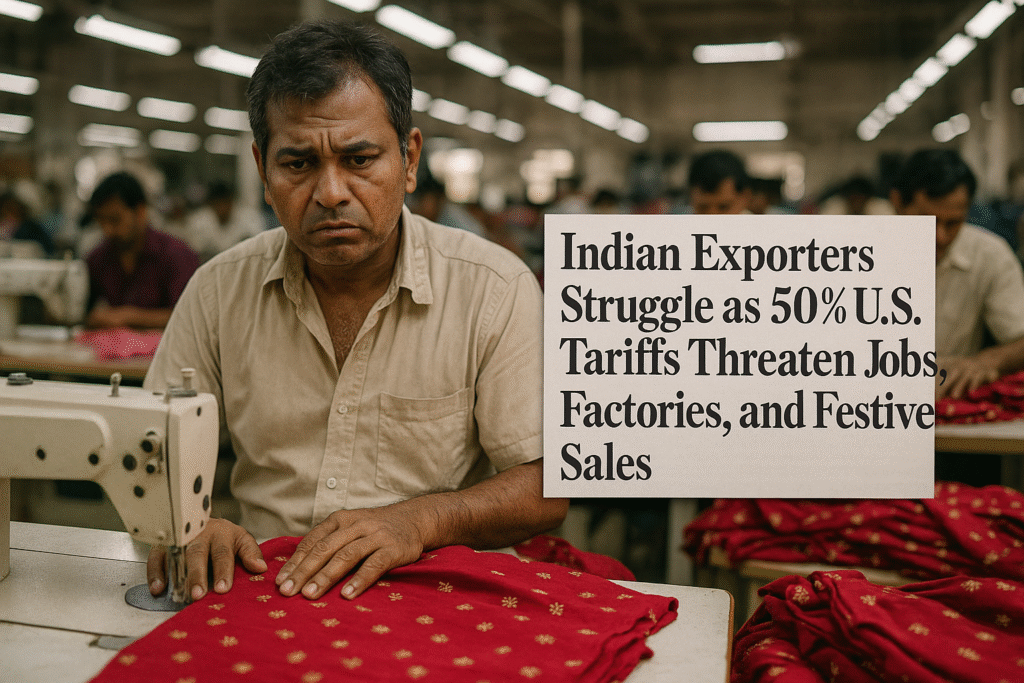
As millions of Indians celebrated Diwali this week with prayers for prosperity and fortune, the nation’s exporters faced a grim reality — punishing 50% U.S. tariffs that have crippled key sectors like textiles, gems, jewelry, and handicrafts.
The United States remains India’s largest export market, accounting for over $45.8 billion — nearly 20% of total exports between April and September 2025. But since August, when Washington imposed steep tariffs on Indian goods, exporters have been grappling with soaring costs, idle factories, and growing layoffs.
For industries heavily dependent on U.S. orders — such as textiles and jewelry — the blow has been devastating. Both sectors employ more than 50 million workers combined, many of whom now face uncertainty about their livelihoods.
Textile Sector in Crisis
“Their situation is bad. There is no business, crores of rupees are stuck in unsold inventory, and the machines are lying idle,” said Ajay Kapoor, owner of a Mumbai-based textile sourcing firm that supplies to U.S. retail giants like Walmart and Macy’s.
Textile manufacturers, who typically require six months to prepare garments based on American retail guidelines, found themselves trapped when tariffs came into effect mid-production. Many are now unable to move finished goods or recover material costs.
Data from India’s Ministry of Commerce shows textile exports plunged nearly 10% year-on-year in September — a sharp reversal from July’s 5% growth before the tariffs.
In Surat, one of India’s largest textile hubs, businesses like Parnika India, which supplies ethnic wear to 150 U.S. stores, have begun scaling back operations. Managing director Vishal Pacheriwal said weak domestic demand during Diwali has only worsened the problem. “The drying up of orders in U.S. business coupled with slow domestic sales has left me with inventory. It’s financially prudent to cut production,” he admitted.
Gems and Jewelry Lose Their Sparkle
The impact has been equally harsh for India’s $30 billion gems and jewelry sector — long a symbol of craftsmanship and export success.
Rajesh Rokde, chairman of the All India Gem and Jewelry Domestic Council, estimates the industry could lose up to $9 billion in revenue due to U.S. tariffs. “Exporters have been hit badly. Generally, a sector can absorb a 10% hit, but when over 30% of its exports are impacted, it is a big blow,” Rokde said.
About one-third of India’s jewelry exports go to the U.S., dominated by diamond pieces that account for nearly 80% of total shipments. However, even as global demand for luxury items softens, tariffs have made Indian goods uncompetitive.
ICICI Securities, in an October 18 report, noted that while jewelry exports grew a marginal 0.4% year-on-year in September, the figure pales in comparison to July’s 28.9% surge before tariffs.
Furniture and Handicrafts Also Hit
In Jodhpur, a hub for wooden furniture and handicrafts, exporters are facing what they describe as an existential crisis.
“Our exports have fallen sharply,” said Raunak Singhvi, who runs a family-owned furniture export firm. “We invested heavily during the pandemic when U.S. demand spiked, but now many factories have shut down, people have lost jobs, and American importers are asking for steep discounts.”
Jodhpur’s annual furniture production — valued at roughly ₹50 billion ($570 million) — relies on the U.S. for half its export revenue. With tariffs now exceeding 50%, Singhvi says even survival is in question. “A tariff of 15% is manageable, but anything above 25% is a catastrophe,” he said.
Hope for a Breakthrough
There may, however, be a glimmer of hope. According to reports by Indian business daily Mint, trade negotiators from Washington and New Delhi are close to finalizing a deal that could slash tariffs to around 15–16%.
If successful, the agreement could revive U.S. orders, stabilize employment, and help restore India’s export growth engine. But without relief, exporters warn the damage could become irreversible.
“A tariff cut could be the lifeline we’ve been waiting for,” said Kapoor. “Without it, many of us won’t make it past the next quarter.”
As India’s festive lights fade, its exporters await Washington’s next move — one that could determine whether 2025 ends in recovery or recession for millions who power the nation’s export economy.