
By Harshit, Washington | 22 OCT, 2025 7AM EDT
Ranchers Raise Concerns Over Beef Imports
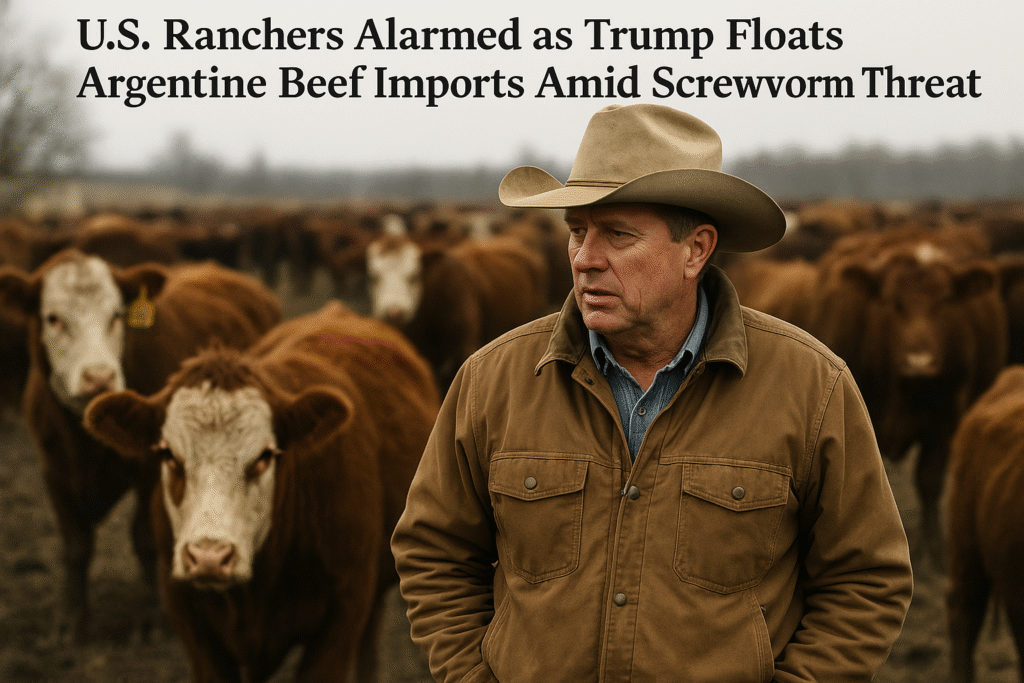
U.S. cattle ranchers are voicing concerns after President Donald Trump suggested importing beef from Argentina, following his administration’s recent bailout plan for the South American country. The idea has sparked debate, with domestic producers warning that it could distort markets at a time when the U.S. beef supply chain is already under strain.
Cattle farmers argue that the real challenges lie in dwindling herds due to prolonged drought and the resurgence of the New World screwworm, a parasitic fly that can devastate livestock. They say the government is not doing enough to address these underlying issues.
Screwworm: A Growing Biosecurity Threat
The New World screwworm, eradicated from the U.S. in 1966, lays eggs in open wounds of warm-blooded animals. The larvae feed on tissue, potentially killing affected animals if untreated. Human cases are rare but can occur, as in August 2024, when a Maryland resident returning from El Salvador was infected.
Recent outbreaks in Mexico have heightened U.S. ranchers’ anxiety. Mexico’s National Service of Agro-Alimentary Health confirmed a case in Nuevo Leon, a border city, marking the second confirmed case in two weeks. In response, the U.S. Department of Agriculture (USDA) has repeatedly closed the border to imports of live cattle, bison, and horses from Mexico. Before the closures, over one million Mexican calves entered the U.S. annually, representing roughly 3.3% of the U.S. calf crop.
Texas, a key contributor to U.S. beef production, faces significant risk. “Millions of beef cattle along the southern border alone are at potential risk,” said Andrew Coppin, CEO of Ranchbot Monitoring Solutions.
Drought and Herd Decline
The U.S. cattle herd has shrunk to approximately 94.2 million head, the lowest since 1951, largely due to severe drought conditions affecting about 30% of the country. Limited grasslands and water shortages are reducing herd sizes, increasing feed costs, and driving beef prices to record highs.
James Clement III, a sixth-generation Texas rancher, explained the challenges: “We require less labor now, so it’s difficult to detect an infected animal. Most cattle roam free across large pastures, and there aren’t enough people to check every head daily.”
Market Implications of Argentine Beef Imports
Trump’s suggestion to import Argentine beef briefly influenced live cattle futures, though prices have since rebounded. Ranchers and supply chain experts argue that such interventions provide a temporary fix for consumers while doing little to address structural issues like drought and disease.
“The market will take care of itself,” Clement said. “We need the government to focus on biosecurity and disease prevention—not market manipulation.”
The National Cattlemen’s Beef Association (NCBA) echoed this sentiment, warning that importing beef could “create chaos at a critical time of the year for American cattle producers while doing nothing to lower grocery store prices.” Republican Senator Deb Fischer of Nebraska also urged reconsideration of the proposal.
USDA and Administration Response
U.S. Agriculture Secretary Brooke Rollins acknowledged the proposal on CNBC’s “Squawk Box,” emphasizing the need to reshore U.S. beef production and enhance domestic supply chains. Rollins highlighted ongoing government efforts, including a sterile insect technique (SIT) program to control screwworm spread. She noted that while domestic sterile fly production is under development, full implementation is still two to three years away.
Rollins also stressed that Argentina contributes relatively little to U.S. beef consumption—approximately 2 million metric tons of the 12 million metric tons consumed annually. She warned of potential biosecurity risks, including foot-and-mouth disease, which could devastate domestic herds.
Looking Ahead
Ranchers are beginning to rebuild herds, but experts say it will take two years to significantly increase beef output. Coppin emphasized the importance of water and grasslands in supporting sustainable herd growth.
The current situation underscores the broader challenges facing U.S. cattle producers: balancing biosecurity threats, climate-related supply constraints, and market pressures while maintaining profitability.
“The government’s role should be disease prevention and biosecurity, not market manipulation,” Clement said. “Once those fundamentals are addressed, the next generation can be encouraged to pursue ranching with confidence.”