
By Harshit, London | October 22, 2025
Inflation Remains Above Target
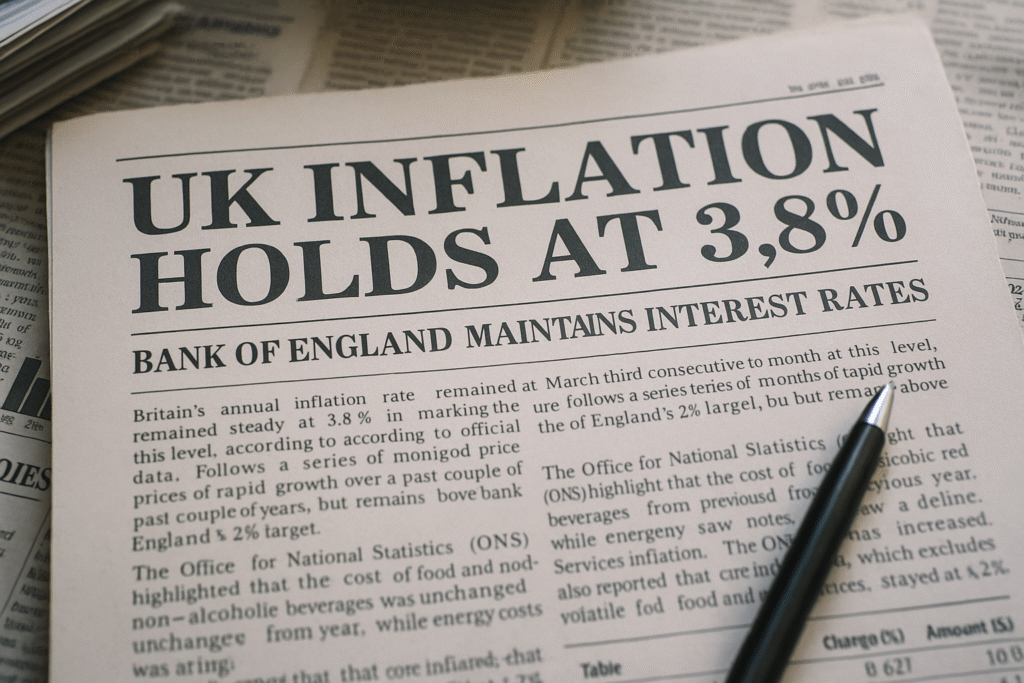
The United Kingdom’s annual inflation rate remained steady at 3.8% in September 2025, matching the figures recorded in July and August. The Consumer Prices Index (CPI) remains well above the Bank of England’s (BoE) 2% target, reflecting continued price pressures across households.
While inflation has eased considerably from its October 2022 peak of 11.1%—the highest in 40 years—it remains elevated. Analysts say energy and food prices continue to exert upward pressure, even as growth in other sectors has slowed.
Understanding UK Inflation
Inflation measures how much prices rise over time. For example, if a bottle of milk costs £1 today and £1.05 a year later, that represents a 5% annual increase. The Office for National Statistics (ONS) tracks hundreds of everyday goods and services—including food, fuel, and increasingly popular items like virtual reality headsets and yoga mats—to calculate CPI.
The main measure used by the BoE excludes volatile food and energy prices, known as core inflation, which stood at 3.5% in the year to September, slightly down from 3.6% in August.
Drivers of Inflation
Inflation has remained high due to multiple factors:
- Energy Costs: Prices surged after increased demand post-COVID-19 and geopolitical tensions in Eastern Europe.
- Food Prices: Food inflation was 4.5% in September, slightly lower than August’s 5.1%, though still a key contributor. Supermarkets have passed on government-mandated increases in minimum wages and National Insurance Contributions to consumers.
- Transport and Services: Petrol prices and airfares fell less than in the same period last year, sustaining upward pressure on CPI.
While overall price growth has moderated, economists emphasize that inflation slowing does not mean prices are falling—it simply indicates that the pace of increase has decelerated.
Bank of England Interest Rate Policy
The Bank of England has cut interest rates five times since August 2024, lowering the key rate from 5.25% to 4% by August 2025. Rate cuts are designed to stimulate spending and investment by making borrowing cheaper, counterbalancing the drag from high inflation.
Governor Andrew Bailey has stressed that future rate adjustments will be gradual, reflecting the delicate balance between supporting the economy and keeping inflation under control. At the BoE’s September meeting, rates were held steady at 4%, in line with market expectations.
The BoE faces complex considerations: global economic uncertainty, including U.S. tariffs and conflicts in the Middle East, can influence domestic price pressures. The upcoming Autumn Budget on November 26 may also affect monetary policy decisions.
Wages and Employment Trends
Pay growth in the UK has kept pace with inflation in recent months. Between June and August, regular pay excluding bonuses grew by 4.7%, translating to a real wage increase of 0.9% after accounting for CPI. Public sector pay rose 6% annually, while private sector wages increased 4.6%.
Despite these gains, labor market indicators show softening. Vacancies fell by 9,000 (1.3%) to 717,000 between July and September, continuing a downward trend over the past three years. Meanwhile, the unemployment rate edged up to 4.8% in the three months to August, the highest since June 2021.
Global Context
Inflationary pressures are not unique to the UK. The Eurozone’s inflation rate rose to 2.2% in September, while the European Central Bank (ECB) has gradually reduced its key interest rate to 2% by June 2025. In the United States, inflation increased to 2.9% in August, prompting the Federal Reserve to cut its target lending rate to 4–4.25% in September 2025 to support the labor market.
These global developments are relevant for the BoE, which must weigh external inflationary pressures alongside domestic economic conditions when setting policy.
Outlook
The UK economy faces a challenging environment where inflation remains above target, wages are slowly catching up, and labor market conditions are softening. The Bank of England is expected to continue a cautious approach to monetary policy, with gradual rate adjustments that balance supporting growth against controlling inflation.