
By Harshit | October 21, 2025 | New Delhi, India | 11:00 AM IST
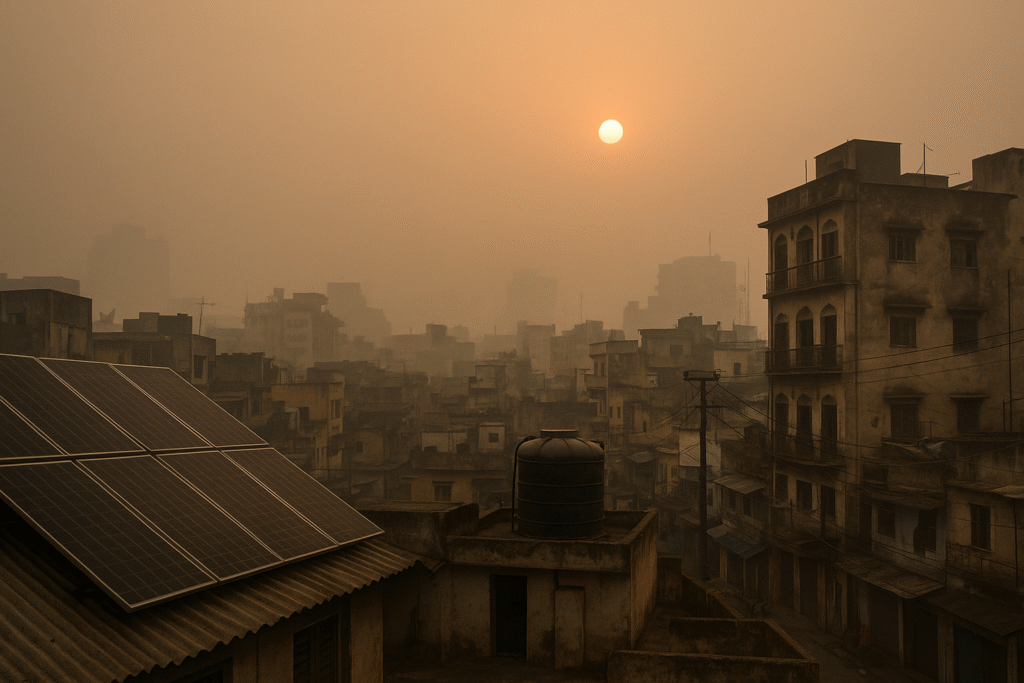
India’s skies are dimming. A new study by six Indian scientists finds that over the past three decades, sunshine hours — the time direct sunlight reaches Earth’s surface — have steadily declined across most of the country, driven by clouds, aerosols, and local weather patterns.
Published in Scientific Reports, a peer-reviewed journal from Nature Portfolio, the study draws on data from 20 weather stations spanning 1988 to 2018. The findings show a persistent drop in sunshine nationwide, with the exception of a slight seasonal reprieve in the northeastern region. The steepest declines occurred in northern inland cities, including Amritsar and Kolkata, along the Himalayan belt, and on the west coast, notably Mumbai.
“Shrinking sunshine hours are linked to clouds that linger longer without releasing rain, blocking more sunlight. These longer-lasting clouds form indirectly due to aerosols that alter weather and climate,” says Manoj Kumar Srivastava, professor of geophysics at Banaras Hindu University and co-author of the study.
Aerosols, Smog, and Seasonal Patterns
Air pollution exacerbates the loss of sunlight. During winter, heavy smog, temperature inversions, and crop burning in the Indo-Gangetic plains create light-scattering aerosols that reduce sunlight intensity. Aerosols — tiny particles from dust, vehicle exhaust, crop burning, and industrial emissions — persist in the atmosphere long enough to affect both sunlight and climate.
From June to July, monsoon clouds blanket much of India, sharply reducing sunlight even though aerosol levels drop. Between October and May, sunshine hours rise, but hazy winter sunlight often diffuses through pollution, lowering intensity while instruments still register the hours.
According to Sachchida Nand Tripathi, atmospheric scientist at IIT Kanpur, aerosols have reduced the amount of sunlight reaching India’s surface by about 13%, while clouds accounted for an additional 31–44% drop in surface solar radiation between 1993 and 2022.
Implications for Solar Energy and Agriculture
India’s renewable energy ambitions are particularly vulnerable. Solar power now contributes 47% of the country’s renewable capacity, with over 100GW of solar installed by early 2025 and a government target of 500GW of renewables by 2030. However, declining sunlight could hinder solar output, with pollution reducing photovoltaic efficiency by 12–41%, costing an estimated $245–835 million in lost energy production.
Cleaner air could boost annual solar generation by 6–28 terawatt hours, enough to power millions of homes, while also improving crop yields. Pollution already diminishes agricultural productivity, with rice and wheat losses estimated at 36–50% in the most affected regions, according to Tripathi.
India in a Global Context
India is not alone in experiencing dimming skies. Europe saw reduced sunshine from 1970–2009 due to industrial emissions and clouds, with Germany losing 11% of sunshine hours between 1951–1980. China also experienced significant declines from the 1960s to 2000s, primarily from aerosols linked to rapid industrialization.
Yet global brightening — a gradual increase in sunlight at Earth’s surface since the 1980s due to falling aerosols and cloud shifts — has largely bypassed India. The country’s ongoing pollution crisis means it is missing out on the potential benefits of clearer skies.
A Warning for the Future
Declining sunlight has wide-ranging consequences. Beyond energy generation, reduced solar exposure affects agriculture, ecosystems, and daily life. Cities like Mumbai may continue to see incremental drops in sunshine hours, even as government programs push for renewable energy adoption.
The study highlights the need for air quality improvements and stricter emission controls, not only for public health but also to safeguard India’s climate and energy ambitions. Without concerted action, India risks running on “fumes instead of full power,” with dim skies limiting both renewable energy potential and agricultural productivity.
As scientists continue to monitor sunlight and air quality, the study serves as a stark reminder: pollution is not just a health hazard — it is literally casting a shadow on India’s future.