
By Harshit | Washington, D.C. | October 21, 2025 | 1:30 AM EDT
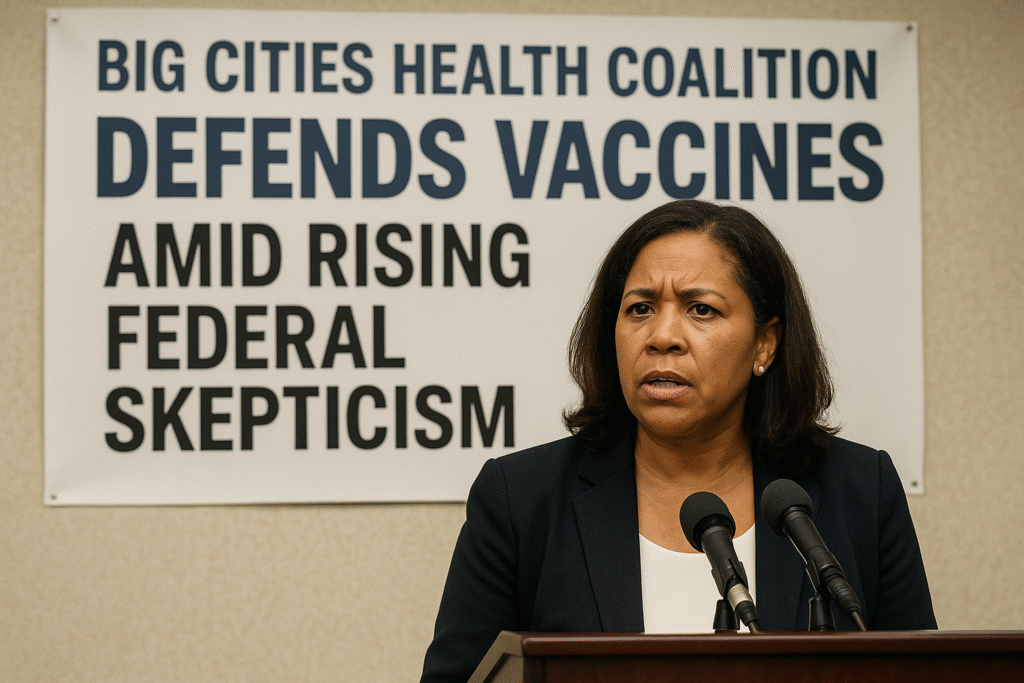
As misinformation about vaccines intensifies and federal guidance becomes increasingly politicized, public health officials from the nation’s largest cities are taking a united stand. The Big Cities Health Coalition (BCHC), representing over a fifth of the U.S. population, has released a powerful statement urging Americans to get vaccinated — and calling out what they describe as “false claims” from federal leaders.
“We are united behind a simple message: get vaccinated,” the group wrote in a joint declaration Monday, signed by more than two dozen health directors from major U.S. cities, across both Republican- and Democrat-led states.
Public Health Leaders Sound the Alarm
Vaccination, the coalition emphasized, has saved millions of lives. Yet falling vaccination rates nationwide have contributed to resurgences of preventable diseases like measles and polio, which had once been nearly eradicated in the United States.
“We are deeply troubled by repeated false claims about vaccines from too many federal officials,” the statement read. “These have contributed directly to vaccine hesitancy and new outbreaks.”
The group also criticized recent federal actions, including revisions to childhood and adult immunization schedules that, they argue, “unnecessarily limit access to vaccines” as the country heads into a new respiratory virus season dominated by Covid-19 and influenza threats.
Alt text: Healthcare worker preparing a vaccine syringe in a clinic, symbolizing vaccination awareness.
Federal Decisions Under Scrutiny
Last month, vaccine advisers to the U.S. Centers for Disease Control and Prevention (CDC) voted to recommend against the combined MMRV vaccine — which protects against measles, mumps, rubella, and varicella — for children under age four. A new working group is also reviewing the broader vaccine schedule to assess timing, safety, and necessity.
President Donald Trump, at a recent Cabinet meeting, made several incorrect claims about vaccines, including that “babies get 82 vaccines in a single shot,” a statement that medical experts have debunked as false.
Amid this environment of confusion, local health leaders say they felt compelled to act. “We have to make our public health decisions based on data, not political ideology,” said Dr. Phil Huang, director of Dallas County Health and Human Services. “We have to be the voices for science and reason.”
The U.S. Department of Health and Human Services (HHS) responded in a statement to CNN, noting that vaccines “can be an important tool to prevent disease” but emphasizing a renewed focus on “restoring the doctor–patient relationship so people can make informed decisions.”
Medical Community Pushes Back
The BCHC’s letter joins a growing chorus of professional organizations that have broken ranks with the CDC amid increasing federal inconsistency on vaccine guidance. The American Academy of Pediatrics, the American College of Obstetricians and Gynecologists, and several other medical groups have recently issued independent recommendations reaffirming vaccination’s critical public health role.
Alt text: City public health officials at a press conference emphasizing vaccine safety and awareness.
The BCHC, formed more than 20 years ago, has long served as a collaboration hub for city health departments addressing infectious diseases, environmental hazards, and emergency responses. But members say today’s political and social environment poses unprecedented challenges.
“The threats are growing and becoming more complicated,” said Dr. Raynard Washington, public health director for Mecklenburg County, North Carolina. “There’s a lot of conversation happening about how, in the absence of a strong federal public health system, we can still protect our communities.”
Coordination Amid Fragmentation
A recent measles outbreak in upstate South Carolina — just 100 miles from Washington’s jurisdiction — highlights the urgency. “I don’t have walls to stop people from traveling between states,” Washington said. “Our local health system is only as strong as the weakest county or jurisdiction. Collaboration is the only way forward.”
Over 100 unvaccinated students in South Carolina are currently in quarantine after exposure to measles, underscoring the risks of declining immunization rates.
Vaccines, the coalition stressed, “keep classrooms safe and schools open. They allow children to spend time with friends and help parents continue working to support their families.”
The BCHC’s message is clear: science must guide public health policy, not politics.