
By Harshit
WASHINGTON, DECEMBER 25, 2025 —
As 2025 comes to an end, energy researchers and policymakers increasingly describe the year as a turning point in the global transition toward renewable power. While fossil fuels continue to play a significant role in the world economy, the pace of investment, deployment, and policy support for clean energy accelerated notably over the past twelve months.
Rather than a sudden transformation, experts emphasize that 2025 reflected a structural shift—one driven by economics, energy security concerns, and technological maturity rather than environmental advocacy alone.
Renewables Move From Alternative to Mainstream
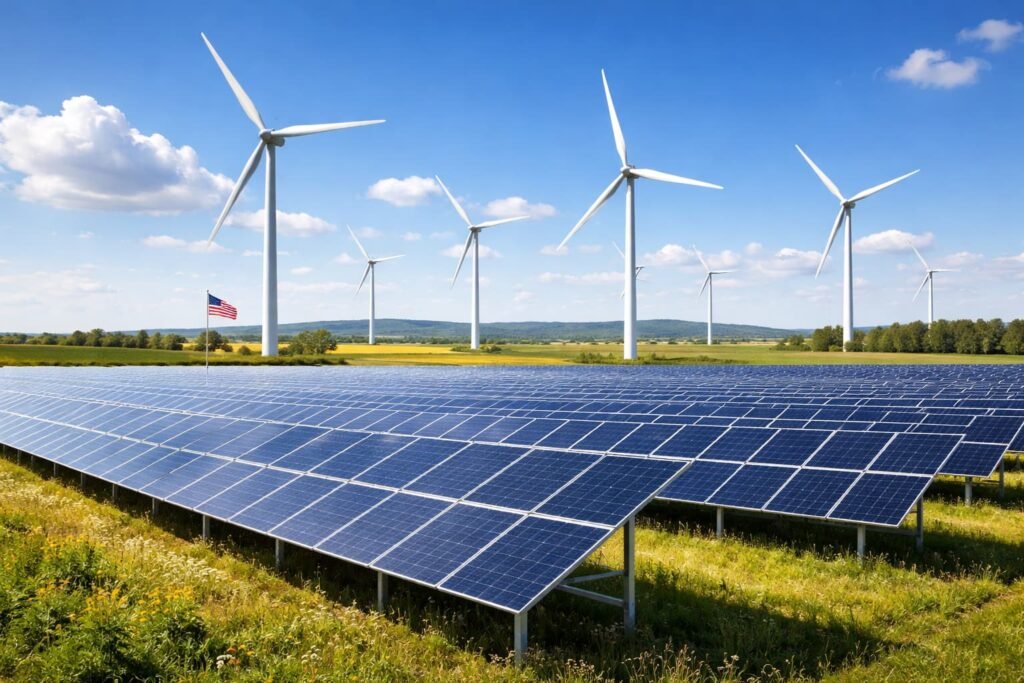
For much of the past two decades, renewable energy was framed as a supplement to conventional power sources. In 2025, that framing changed. Solar and wind power became central components of new electricity generation capacity in the United States and many other major economies.
According to data compiled by the U.S. Energy Information Administration, renewable sources accounted for a growing share of newly added power capacity, outpacing coal and rivaling natural gas in several regions. Declining technology costs and faster project timelines made renewables increasingly attractive to utilities and private investors.
Falling Costs and Technological Maturity
One of the most important drivers of the 2025 shift was cost. Solar panel prices continued a long-term downward trend, while wind turbine efficiency improved through better design and materials. Battery storage technology also advanced, addressing one of the long-standing challenges of renewable energy: intermittency.
Energy analysts note that renewables are no longer dependent on subsidies alone. In many markets, new solar or wind projects can now produce electricity at costs competitive with—or lower than—traditional fossil fuel plants.
This economic reality has reshaped energy planning decisions across both public and private sectors.
Energy Security and Geopolitical Pressures
Energy security emerged as another major factor accelerating renewable adoption. Volatility in global energy markets over recent years reinforced concerns about dependence on imported fuels and exposure to geopolitical risk.
Renewable energy, by contrast, relies on domestic resources such as sunlight and wind. Governments increasingly view clean energy infrastructure as a strategic asset that enhances resilience and reduces vulnerability to external shocks.
In the United States, federal and state-level policies supported domestic manufacturing of clean energy components, reinforcing supply chain stability alongside climate goals.
Grid Modernization and Infrastructure Investment
The expansion of renewable energy in 2025 was accompanied by significant investment in grid modernization. Aging electrical infrastructure, originally designed for centralized fossil fuel generation, is being adapted to accommodate decentralized and variable renewable sources.
Utilities invested in smart grid technologies, advanced transmission systems, and energy storage to improve reliability. These upgrades are widely viewed as essential to sustaining higher renewable penetration without compromising system stability.
Researchers at the National Renewable Energy Laboratory emphasized that grid flexibility—not generation capacity alone—will determine the long-term success of the energy transition.
Economic and Employment Impacts
The growth of renewable energy also carried measurable economic implications. Clean energy industries supported a rising number of jobs across manufacturing, construction, maintenance, and research. While employment shifts remain uneven across regions, renewable projects have become an important source of investment in rural and industrial communities.
Economists caution that workforce transitions require targeted training and support, particularly in regions historically dependent on fossil fuel industries. However, they note that long-term employment prospects increasingly favor energy technologies aligned with global decarbonization trends.
Challenges That Remain
Despite progress, experts stress that the energy transition remains incomplete. Fossil fuels still dominate global energy consumption, particularly in transportation and heavy industry. Supply chain constraints, permitting delays, and local opposition continue to slow some renewable projects.
Additionally, scaling energy storage and modernizing transmission infrastructure will require sustained investment and regulatory coordination.
Scientists also emphasize that renewable expansion alone cannot address climate risks without parallel improvements in efficiency, conservation, and emissions reduction across sectors.
Looking Ahead to 2026
As the world enters 2026, energy researchers expect renewable deployment to continue growing, though at a measured pace shaped by infrastructure readiness and policy stability. The developments of 2025 suggest that clean energy has moved beyond experimentation into a phase of long-term integration.
Rather than a symbolic milestone, 2025 may be remembered as the year renewable energy became a foundational element of modern energy systems—reshaping how nations think about power, security, and economic resilience.